Hatch Blog
The Leadership Behaviors That Need to Change
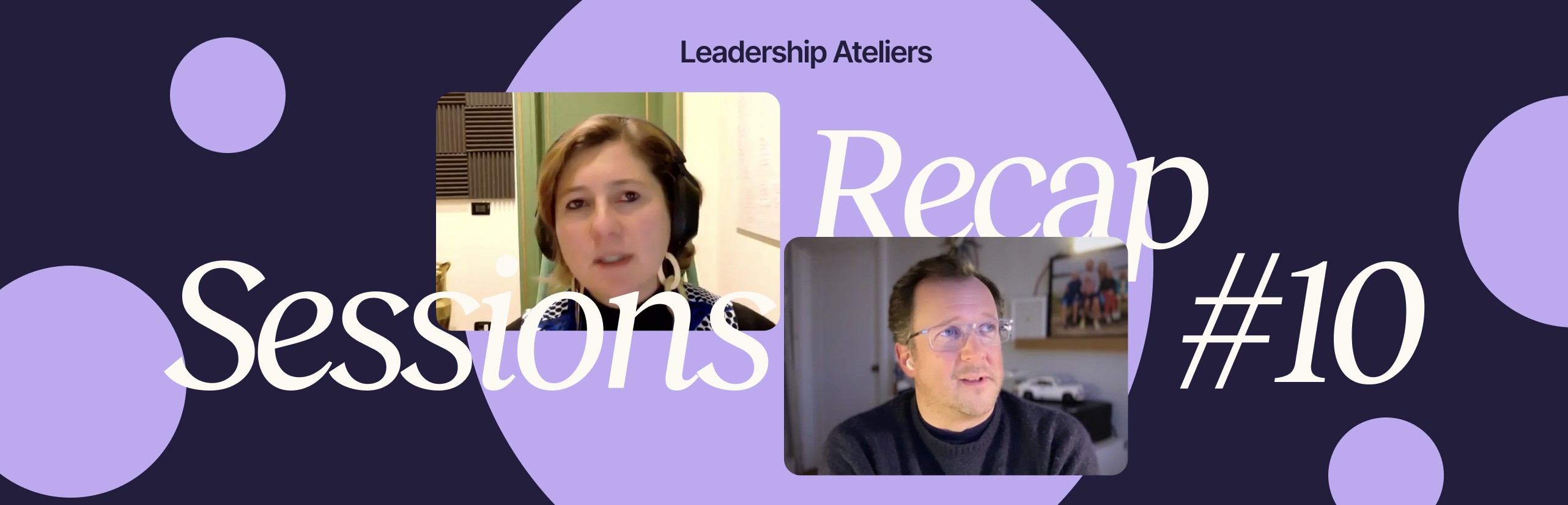
When asked about leadership behaviors that used to be rewarded but are now unhelpful, both speakers pointed to a fundamental shift in what organizations value.
Marzia noted two extremes she sees in design leaders today: those who've given up on creating impact and just do the minimum needed, and those desperately trying to prove design's relevance in organizations that may not actually need what they're selling.
"A lot of organizations I work with are very large corporates in financial services, telecommunications, luxury retail," Marzia explained. "These are organizations that for hundreds of years have been fine. Then you arrive with design thinking, saying you have answers to all the problems that haven't been fixed yet. That is usually not necessarily seen as a good thing."
The leadership behavior that needs to evolve? The savior complex. The belief that design has all the answers.
The Blurring Lines Between IC and Management Roles
A major theme in the conversation was the changing relationship between individual contributor (IC) roles and management tracks.
Steve described how his current company, Tem Energy, has created a two-tier IC system: IC1-2-3 for standard individual contributors, and E1-2-3 for "experts" with deep domain knowledge who can reach senior levels without managing people.
"The IC role in design, not just in design actually, in business, particularly in startup scale-up, is super critical," Steve said. "I've always been an advocate of the IC role can go all the way to the top, and you don't have to go to management."
The challenge comes when someone transitions from expert (E) to manager (M). "You've got this sliding scale of moving to hands off the tools to being more in the coaching, mentoring, training, performance management, resource capping," Steve explained. "If they're not well prepared for what that feels like, then often you get people going, I hate this, I want to go back to being the IC."
Marzia added that she's seeing more design leaders who came from completely different backgrounds, fell in love with design, and bring organizational understanding that creates more impact than traditional design training alone.
How to Decide When to Intervene as a Leader
One participant asked about deciding when to intervene when things are emotionally charged.
Marzia's answer: "Read the room."
"If someone is not capable to hold that conversation in that room in that moment, you need to step in," she said. "If they're capable, they will learn a lot if you let them figure it out. So it's about, you know, learning how to read the room, read the dynamic."
Steve added that he tries to be clear with his team about the types of things that will trigger his intervention, then focuses on checking his own anxiety. "Am I stepping in because something is wrong, or am I stepping in because I'm uncomfortable with not knowing something?" he asked.
"You've got to read the room, but you've also got to just check yourself and your own motives of why you're doing it," Steve said. "You're part of the room."
Advice for Brand New Design Managers
For someone two months into their first management role, both speakers had clear guidance.
Marzia's advice:
Understand the real constraints of your role. "Usually people get into these roles thinking, oh my god, this is like a step up, and I can do a lot more, and I can own decisions. But the reality, very often, is very different."
Don't shield your team, support them. "The team doesn't need protection. The team needs air cover and the right motivation. Air cover to actually do their job in the way they think it's right, and motivation to actually do it. And that doesn't mean shielding them from the reality of the organization."
Steve's advice centered on emotional preparation:
Get comfortable not always being liked. "You're going to have to make decisions that aren't necessarily going to please everyone. People will talk about you. You've got to be comfortable with that."
Expect to spend less time with designers. "You spend less time with designers. You're spending more time cross-functionally as well, and that can be somewhat of a change."
Remember that leadership and management are different. "You don't have to be a manager to lead. You can lead no matter where you are in the organization. It's how you bring people along."
Steve also recommended Julie Zhou's book "Making of a Manager" as an accessible resource for new managers.
The Real AI Challenge: Infrastructure, Not Tools
When discussing AI, both speakers made clear the challenge isn't about learning tools.
Steve used an electric bike metaphor: "A computer is a bike for the mind. A computer with AI is an electric bike for the mind. It gives you a whoosh to get up to speed, but then you're on your own and you've still got to pedal. You've got to really analyze what the outputs are and how it's actually helping you."
"If AI can do all this stuff, then I don't need to hire smart, capable, rational people," Steve said. "That's clearly not the case. There's always a level of interpretation, there's the human factors."
Marzia went deeper on the organizational implications: "AI is a change to infrastructure, not to the toolkit. It has profound implications on the way we work, the way we organize work, and the value that we generate for customers."
She shared an example of a large Dutch bank that tried to use AI to improve corporate client checks. They treated it as a tool instead of infrastructure, resulting in a system that hallucinated, had no clear governance, and ended up unused by analysts.
"There was absolutely no clarity on what was the governance around that," Marzia explained. "AI cannot decide itself. You cannot fire AI because they made the wrong call. But there was absolutely no clarity on whose responsibility it was."
"I see more and more design leaders actually stepping in and asking uncomfortable questions, pushing the boundaries of what the work and practice can do beyond the usual," Marzia said. This is where design leaders can add real value around AI.
The Leadership Events Design Leaders Actually Need
Most design conferences focus on showcasing work or teaching technical skills. What's missing are spaces where leaders can work through strategic challenges with experienced peers and facilitators.
The most effective leadership development happens through:
Guided peer learning: Working through real challenges with other leaders at similar stages, facilitated by someone who has navigated similar situations
Practical frameworks: Tools you can apply immediately, not theoretical models that sound good in presentations but fail in practice
Honest conversations: Spaces where admitting you don't have all the answers is welcomed, not penalized
This is why Leadership Ateliers creates small, focused events rather than large conferences. With 50-80 attendees max, leaders can dig into specific challenges rather than networking superficially.
Ready to develop these skills with experienced peers and facilitators? Leadership Ateliers offers intimate, hands-on events across four European cities. Each focuses on specific leadership challenges with practical frameworks you can apply immediately.
Join in Barcelona, Lisbon, Berlin or Amsterdam