Hatch Blog
You get promoted. Suddenly you're responsible for other people's growth, the team's output, and decisions you used to just execute on. And the skills that got you here, being fast, precise, opinionated about craft, do not automatically transfer.
Two things tend to separate the leaders who grow quickly from the ones who quietly struggle.
The first is delegation. Not just handing off tasks, but genuinely transferring ownership of outcomes. The second is operational clarity: building the conditions where your team can do good work without you in every conversation.
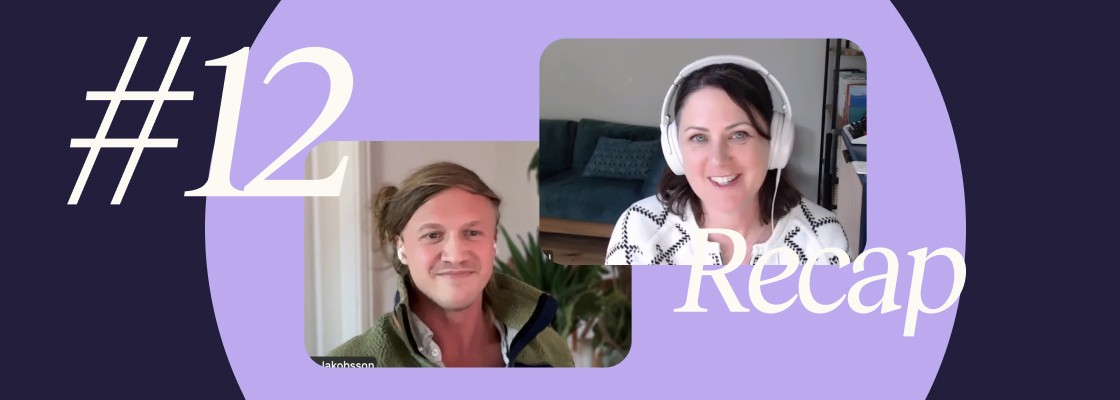
We hosted a live session on exactly this with Rachel McConnell, Senior Design Manager at Miro, and Petter Jakobsson, Director of Product Design at Oviva (formerly leading growth design at Vinted). Eighty designers and design leaders joined. The questions they submitted beforehand were honest, specific, and very familiar.
Here's what came out of the conversation.
Start by Diagnosing, Not Fixing
The first question, our host Nat Di Pasquale put to the panel was about entering a new team. There is usually a temptation to jump straight into changes. Both Rachel and Petter pushed back on that instinct hard.
Petter's approach is to figure out who actually owns what. Not what the org chart says, but what's really happening. He asks people what they're working on this week and where they feel stuck. The gap between those two things tells him more than any onboarding document.
He also looks for what the team has stopped trying to fix.
"Every team has a list of things that maybe used to bother them, but don't anymore. Not because the issues went away, but because they gave up pushing for it."
That list is where the real culture lives.
Rachel approaches a new team the way she approaches design discovery: gathering signals from every angle at once. Skills, personalities, ways of working, workarounds. And, critically, how the team is perceived by the people around them.
"What do stakeholders expect from this team? And is that aligned with what the team should actually be doing?"
It is a surprisingly underasked question. Misaligned expectations, left unexamined, become the invisible ceiling on everything the team tries to do.
Delegation Is Not Task Assignment
This was the sharpest distinction of the whole session, and the one that generated the most reaction in the chat.
Petter put it plainly: "Delegating a task is not even delegating. That's assigning a task. Delegation means ownership."
He described a situation early in his career where he had handed off a design problem to someone on his team, a checkout flow. The designer kept coming back to him for sign-off on every decision. Petter realised he had delegated the task but not the ownership.
"I sat down with her and said, this is really your problem to solve. You are the one making the decisions. I'm just here to back you up."
The shift was immediate. The quality of the work improved. The designer stopped designing for his approval and started designing for the user.
The practical framework he uses for knowing when and how to delegate comes down to two questions. Does this person have the skill? And do they have the will?
If the skill is missing, that is workable. You delegate with closer feedback loops and shorter check-ins. If the will is missing, delegation does not fix it. That is a different conversation.
He also separates decisions by reversibility. Reversible decisions he fully delegates, because that is where people learn fastest. Irreversible ones, he stays closer to the work, especially with more junior team members.
Operational Clarity Is What Makes Delegation Stick
Rachel's contribution on this was equally concrete.
She described a 360-degree skills assessment she runs when entering a new team. She lists out specific skills, asks people to rate their own confidence in each one, and then cross-references that with feedback from the people they work with. The goal is not to catch gaps. It is to understand where she can help people grow.
"I'm always erring towards, how do I help you get there? Not, what haven't you got that you should have?"
She also made a point about the culture around asking for help. Teams where people feel safe to surface problems early are teams where leaders can delegate confidently. If someone gets out of their depth and says nothing until it's a disaster, delegation becomes high-risk. If they know they can raise a hand and the team will respond, the leader can let go further and earlier.
"Fostering a culture where people share work early and often, and ask for help without feeling afraid, that's what makes delegation work over time."
This is what operational clarity actually means. It is less about process and more about removing the friction between where people are and what good work requires.
The Question on AI Nobody Expected
Someone in the audience asked how AI has changed how they think about delegation. Petter's answer went somewhere unexpected.
He said the fundamentals of delegation have not changed. Clarity on the outcome, clear decision rights, the right level of support. Those are stable regardless of what tools a team is using.
But what AI does change is the ceiling on what one person can take on. A designer who is genuinely good with AI can cover more ground, move faster, and produce more in less time.
"The question I'm asking myself now is, am I giving people stretch work? Or am I just filling that extra capacity with more volume?"
The trap is using AI to pile on tasks instead of freeing people up for the thinking that actually develops them. And beyond that, a newer question is emerging: what can you start delegating to agents entirely? What does your team delegate to agents? The pattern of delegation is cascading in ways that weren't possible eighteen months ago.
Rachel's take was simpler but important: what AI has changed is the quality of first attempts. When someone comes to her stuck on how to approach a problem, she asks whether they have tried working through it with AI first. It is not about the tool. It is about the habit of exploring more routes before asking for help.
The Peer-to-Leader Transition No One Talks About
The question about moving from teammate to leader got the most emotional responses.
Petter: "This is honestly one of the hardest transitions in design, and I don't think it gets talked about enough."
Both he and Rachel said the same thing: name the shift explicitly, rather than pretending nothing has changed. Trying to act like you're still one of the gang creates more awkwardness than just acknowledging that the dynamic is different now.
Petter had a direct conversation with his team early in the transition. He told them his role had changed, that some conversations would look different, and that it didn't mean the relationships had to suffer. If anything, naming it made things cleaner.
Rachel made a distinction that matters here. The relationship changes, but it doesn't have to become cold. Her approach is to involve the team in decisions where she can, to solve problems together rather than handing down conclusions. "You're not just there to tell people what to do and get them to execute tasks. You're there to figure things out together."
On performance: Petter pushed back on the idea that support and high standards are in tension. "The most supportive thing you can do for someone is be honest about where they're falling short. Vague encouragement feels kind in the moment, but it leaves people stuck."
What New Design Leaders Cannot Skip
The session closed with a question about non-negotiable skills for designers stepping into leadership. Both panelists had thought about this.
Rachel: communication and listening. And specifically, not feeling like you need to have all the answers just because you have the title. "The best leaders are really good team players who know how to leverage everyone's skills so that collectively you're better than you are individually."
Petter had three.
The first: being able to have hard conversations without softening them into uselessness. "Everything else you could learn on the job. If you can't tell someone directly that something isn't working, you will create problems that compound over time."
The second: understanding the difference between delegating a task and delegating ownership. This one is behavioral as much as conceptual. Teams where leaders only assign tasks sit and wait for instruction. Teams where leaders delegate true ownership move forward on their own.
The third: learning to measure your own success through other people's output. "You spend years being valued for what you personally make. When that changes, it's a real identity shift. The sooner a new leader internalises that, the better they become."
On AI specifically: both pointed to the same thing. The skills that are hardest to automate, judgment, taste, knowing when a direction is wrong before you can articulate why, have always been valuable. AI is just making them more obviously central. The design leaders who thrive are the ones who protect and sharpen those capacities, not just in themselves, but in their teams.
The Bigger Pattern
What Rachel and Petter were describing is a version of the same shift: moving from being the person who does the work to being the person who builds the conditions for good work.
That is not a skill most designers are trained for. It takes time, honest feedback, and usually a few mistakes that you learn from slowly.
What accelerates it is being in the room with people who have done it, asking the questions you're actually stuck on, and getting answers that are specific rather than theoretical.
That is exactly what Leadership Ateliers Berlin is built around. Both Rachel and Petter are running workshops there on May 21 and 22 at Villa Schützenhof. Small groups, practical sessions, real situations brought in by the people in the room.
If today's conversation raised questions you're still sitting with, that is probably the place to keep going.